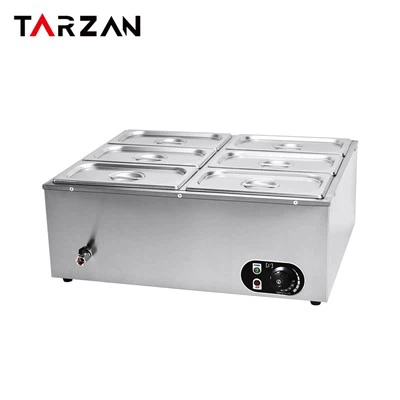
Commercial bain-maries are crucial equipment in restaurant kitchens for maintaining soup temperature and ensuring efficient food preparation. Over long-term use, improper maintenance or inappropriate selection can lead to various malfunctions. This article provides a detailed analysis of common problems and solutions from a usage and maintenance perspective.
Uneven heating or slow heating
|
Possible reasons |
Solution |
|
• Scale or grease buildup on the inner tank surface reduces heat transfer efficiency. • Aging of the heating element or thermostat malfunction. • Clogged steam heating pipes with scale or impurities. |
• Clean the inner tank and heating element regularly using a food-grade descaling agent or stainless steel cleaner. • Check the thermostat probe to ensure it is in close contact with the inner tank surface; replace with genuine parts if necessary. • The steam system requires regular sludge removal and descaling to ensure smooth steam flow. |
Tip: Choose a model with a detachable heating element for easier cleaning and maintenance while also reducing uneven heating.


Temperature control or power supply malfunction
|
Possible reasons |
Solution |
|
• Worn power cord or poor plug contact. • Damaged thermostat probe. • Moisture-damaged or aged internal circuit board. |
• Regularly inspect power lines and sockets, avoiding prolonged bending or pressure on wires. • Ensure the thermostat probe is installed correctly; replace it promptly if damaged. • If the circuit board malfunctions, contact professional repair or the original manufacturer for replacement; avoid attempting disassembly yourself. |
Tip: Devices with overheat protection and leakage protection are safer and more reliable in long-term use.
The inner liner is rusted or corroded
|
Possible reasons |
Solution |
|
• Failure to clean up leftover soup promptly after prolonged storage. • Use of low-grade stainless steel or improper cleaning. • Corrosion caused by detergent residue or excessively high acidity or alkalinity. |
• The soup pot is made of food-grade 304/316 stainless steel, which is resistant to high temperatures and corrosion. • Empty the soup pot promptly after each use and wipe the inner pot dry with a cloth. • Avoid using strong acid or alkali chemicals for cleaning. |
Tip: The removable inner liner design effectively prevents residue from hard-to-reach areas and improves cleaning efficiency.


Overflow and Leakage Prevention
|
Possible reasons |
Solution |
|
• The inner tank is not securely installed or the sealing ring is worn out. • The water level is too high during heating, causing overflow. • The steam connection is loose or not properly sealed. |
• Regularly inspect the inner tank installation and the condition of the sealing rings, and replace any worn seals. • Strictly control the water level within a safe range. • Reinforce or replace the sealing rings if the steam pipe connections are loose. |
Tips: The design with water level markings and a removable sealing ring can significantly reduce operational risks.
Summary and Recommendations
When using commercial bain marie for extended periods, key considerations include heating efficiency, material durability, temperature control safety, leak-proof sealing, and ease of cleaning. The following should be considered during selection and maintenance:
1. Inner Tank Material and Durability: 304/316 stainless steel, high temperature resistant, corrosion resistant.
2. Structural Design: Removable inner tank, sealing ring, water level indicator, overflow prevention design.
3. Safety Features: Overheat protection, leakage protection, dry burning prevention.
4. Ease of Maintenance: The heating element and thermostat are easy to disassemble, clean, or replace.
Mastering these details can not only extend the life of equipment but also ensure food quality and the stability of kitchen operations.